• TEAM
  • WORK
  • PACKAGES
  • BLOG
Get In Touch
  • TEAM
  • WORK
  • PACKAGES
  • BLOG
  • GET IN TOUCH

Search engine optimization (SEO) can feel like a never-ending game of catch-up. Not only do you need to post a steady stream of quality content, but you also need to nail the nuances of technical SEO and tracking performance metrics.

But there’s one area that even the SEO experts can’t seem to agree on: What’s the role of social signals in SEO?

Likes, shares, and comments on Instagram might seem completely unrelated to where your website appears in the search engine rankings, but that’s not entirely true. Google’s John Mueller has shared that while social signals aren’t a direct ranking factor, a strong social media presence can still have a big impact on SEO performance.

From driving organic traffic to building backlinks and boosting brand visibility, integrating social media marketing into your SEO strategy can transform how potential customers perceive your brand. Since being active on social media is a branding best practice anyway, you deserve to get a little SEO juice from your social media efforts, too.

In this guide, we’ll break down how social media platforms work with SEO and share some helpful tips for securing higher positions in the search engine results pages (SERPs).

Should I Care About Social Signals in SEO?

SEO professionals have argued about the role of social media in SEO for years. Search engines are staying suspiciously silent on the exact role that social media plays in SERP rankings, but there’s a good chance it has an indirect impact on your online presence.

Some SEO pros claim that you should focus your resources on creating high-quality content for your website or earning backlinks. And they’re right: These activities are great for boosting SEO!

But that doesn’t mean you should ignore social media, either.

Google doesn’t directly consider social signals, but alternative search engines like Bing do consider them as ranking factors. Google is the top search engine, but overlooking social signals could mean missing out on traffic from other sources.

Ultimately, social media has an influence on your search engine rankings, even if it doesn’t directly affect your Google ranking. You should care about social signals in SEO because they have the power to:

  • Improve online visibility: Engagement on social media sites increases the reach of your content, making it more visible to your target audience. For example, social platforms like Reddit and LinkedIn are great ways to amplify your reach with content distribution. That leads to more organic traffic from users clicking through social posts, plus more linkbuilding opportunities for your brand. These activities tell search engines that your content is valuable, leading to better rankings over time.
  • Boost domain authority: Social signals may not directly affect your Google rank, but they do have an indirect effect on the trustworthiness of your site. For example, social sharing can result in backlinks from credible websites, boosting your website’s ranking. Even unlinked mentions of your brand on social networks can strengthen your site’s SEO performance. Neat, right?
  • Forge a better brand image: What’s good for users is good for search engine rankings. The more people trust you, the better your rankings will be. A strong social media presence increases brand visibility and recognition, offering much-needed social proof that persuades your audience to engage with your brand. Google’s algorithm loves to see engagement, so this is a one-two punch for both sales and search engine rankings.

4 Practical Ways to Integrate SEO Into Your Social Media Strategy

Social media content is the perfect way to meet customers where they are. If you’re already on social media, why not tweak your approach slightly to earn a little SEO power at the same time? Try these practical tips to boost the impact of social signals in SEO.

1. Repurpose High-Performing Content

Look, businesses of all sizes struggle to create content regularly. The good news is that you don’t have to reinvent the wheel every time you post. It isn’t a content marketing faux pas if you repurpose high-quality content.

With this approach, you transform your best pieces into different formats to maximize their reach. For example, you can repurpose blogs into short, engaging videos to boost social media engagement. Share these videos on YouTube, TikTok, and LinkedIn — and don’t forget to pepper in some relevant keywords in the video titles and descriptions. Always link back to the full blog in the video description to earn an easy backlink.

That’s just one approach. You can also turn blogs into visuals, like infographics or Instagram posts, and convert long-form content into carousel posts on Instagram. If you need a lead magnet for LinkedIn, combine a few of your most compelling blogs into a free eBook with a strong call to action (CTA).

Repurposing content is a great way to revisit some of your best ideas in new formats. But if you don’t have the time to crank out content, partner with MBE Group’s SEO and digital marketing pros to transform your big ideas into organic traffic that converts.

2. Create Shareable Content Formats

We love a good blog post, but how shareable is that, really? Engaging content is a must, but you want social media posts that go viral. The best way to reach more folks in your target audience is to create shareable content formats with bite-sized information.

Consider different formats like:

  • Infographics, which are highly shareable on platforms like Pinterest (hello, backlinks!)
  • Short-form videos on TikTok, Instagram Reels, or YouTube
  • Shareable Instagram images with short quotes or tips
  • Polls and quizzes
  • Memes and GIFs

Remember, you don’t have to write an original piece of content every time you post. Recycle ideas from time to time with different formats that will boost engagement and SEO performance.

3. Optimize Social Media Profiles for Organic Search

Here’s a little SEO secret: Search engines care about your social media profile. Make it easier for search engines to find your social media platforms by:

  • Integrating keywords: You don’t need to overdo it, but sprinkling relevant content in your social media profile can improve SEO. Include primary keywords in your bio, username, and post descriptions, if possible. If you target users in a specific location, add a few geo-targeted keywords (like “accounting firm in San Francisco”) to attract more users from your area.
  • Optimizing your photos: As always, make sure you use a professional profile picture and cover photo that aligns with your brand. But before uploading the photo, change the file name to include your primary keywords. Search engines look at back-end data like photo file names, so this little trick could help with ranking.
  • Tweaking your bio: Treat writing a bio like creating a landing page. This is a short paragraph that tells users what you’re about, but it’s also one of the social signals in SEO. Highlight your unique value proposition and include target keywords here. Hashtags are good for discoverability, but use them sparingly so you don’t overwhelm visitors.
  • Linking to your website: Most social platforms allow one link in your bio, so treat this as a juicy backlinking opportunity. You can link to your website’s home page, but consider sharing links to landing pages, e-books, or link trees to funnel users to the right place.
  • Being consistent: Every social media platform is a little different, but your profiles should be relatively consistent across all sites. Users and search engines hate inconsistencies, so if you update one profile, update them all to match.

4. Build Credibility With UGC

User-generated content (UGC) is the holy grail of marketing. Studies have found that UGC is 35% more memorable than other types of content and garners 50% more user engagement. The great thing about UGC is that it turns heads on social media platforms but also serves as a social signal in SEO.

UGC builds brand awareness by leveraging content made by your customers, influencers, and other brands. By leveraging authentic content created by your target audience, you can build trust, increase your number of social signals, and improve your search engine rankings.

However, UGC can be tough to come by, especially for new businesses. Follow these quick tips to generate UGC from multiple social media accounts:

  • Share reviews and testimonials: When you get a testimonial, shout about it from the rooftops! Highlight positive reviews on your social media profiles and website. Use your target keywords in posts about these testimonials to boost their reach in Google search. They’re also a great addition to product pages for e-commerce SEO.
  • Encourage UGC: It takes time, but you can encourage more of your followers to create content around your brand. Consider holding a contest inviting customers to share their experiences with your brand. If you make it fun and lively enough, customers will be eager to share their experiences without the promise of a prize. Create branded hashtags to encourage followers to share their experiences. Cute examples like #ShareACoke create a branded experience that also makes it easier for your team to spot UGC in crowded social media feeds.
  • Integrate UGC in your social posts: Social media platforms like Instagram, TikTok, and Facebook are ideal for sharing user-generated content. Repost customer photos, videos, and stories that showcase your products (with users’ permission, of course).
  • Run ads with UGC: Social media advertising can get pricey, but if you’ve already maximized organic traffic, it’s worth a try. There’s no need to create new content, either. Repurpose customers’ UGC (again, with their permission) to create compelling ads that win over your target audience.

Go Beyond the Algorithms With MBE Group

Social media puts your brand in front of hundreds of potential customers. Some businesses consider SEO and social media to be two separate disciplines. That’s technically true, but there’s synergy between the two that you can leverage to boost website traffic.

Social signals in SEO have an indirect effect on your business. While they won’t revamp your social presence overnight, the tips in this guide will help you see more results from your SEO efforts.

Still, we know that both SEO and social media management aren’t for the faint of heart. While it’s possible to DIY everything, you might not have the extra time on your hands to continually create and share high-quality content.

That’s where we come in. MBE Group crafts strategic content tailored for B2C, B2B, and D2C brands looking to establish brand authority and aiming for greater traffic and growth. Contact us to enjoy the one-two punch of social signals in SEO.
Gone are the days when stuffing keywords into content was enough to rank on search engine results pages (SERPs).

Today’s search engine algorithms have evolved to focus more on what truly matters: the human experience.

So if your website isn’t delivering a seamless and enjoyable user experience (UX), your search engine optimization efforts may fall flat.

But what exactly is the relationship between user experience and search engine optimization (SEO)? And how can you leverage this connection to boost your SEO rankings and drive more organic traffic to your home page and key landing pages? That’s what we’ll help you figure out.

In this guide, we’ll explore how a positive user experience has become a cornerstone of modern SEO strategy and give you actionable tips to optimize your website for both search engines and real people.

Understanding the Relationship Between User Experience and SEO

User experience refers to how people perceive and interact with your website’s user interface (UI) and overall functionality. It encompasses everything from how fast your web pages load to how easily visitors can navigate your site structure.

While traditional SEO strategy placed its focus on technical elements like keyword research and linkbuilding, search engines now factor in user behavior signals when determining search rankings. This shift makes perfect sense, since Google’s primary goal is to serve users high-quality content that satisfies their needs and aligns with their search intent.

Consider these stats about how the user experience affects SEO:

  • The vast majority (88%) of online consumers are less likely to return to a website after a poor user experience.
  • A one-second delay in load time can reduce conversion rates by up to 20% in retail.
  • Mobile users are five times more likely to abandon their task if a site isn’t optimized for mobile-friendliness.

These numbers reveal an important truth: A lack of usability doesn’t just frustrate visitors, it actively harms your digital marketing efforts.

How User Experience Influences SEO Performance

Search engines are getting increasingly sophisticated at measuring how users interact with your site. These user behavior signals serve as indicators that directly impact your search rankings.

Here are four key UX factors that search engines consider to determine your SEO performance:

1. Bounce Rate and Dwell Time

When users click on your website from a search listing but then quickly return to Google (also known as “pogo-sticking”), it signals to search engine crawlers that your content didn’t satisfy the user’s query.

Similarly, “dwell time” refers to how long users spend on a page after clicking on a search result before returning back to the search engine results page.

High bounce rates and low dwell times can negatively impact your user experience and SEO, lowering your position in the SERPs over time.

Conversely, when visitors spend a significant amount of time engaging with your site, it suggests that your web page provides real value. This can boost your position in search engine results.

2. Mobile-Friendliness and Responsive Design

Thanks to Google’s mobile-first indexing, your site’s performance on mobile devices directly impacts your SEO rankings.

With mobile users now accounting for over half of all web traffic worldwide, responsive UX design that adapts seamlessly to different screen sizes isn’t just optimal for usability — it’s an essential ranking factor.

3. Site Speed and Core Web Vitals

Google’s Core Web Vitals — metrics that measure a site’s load performance, interactivity, and stability — have become official ranking factors in Google’s search algorithms.

Remember: Slow page load times frustrate users and can cause them to abandon your site before interacting with your best content or clicking on your calls to action (CTAs). This is especially frustrating for businesses that invest in creating high-quality content, only to have it undermined by technical issues.

At MBE Group, we’ve seen countless clients whose expertly crafted content never reached its full potential simply because these technical factors weren’t properly optimized. That’s why we work with our clients to develop a proactive content strategy and regularly monitor content analytics to identify and resolve any performance issues before they impact rankings.

4. Website Navigation and Site Structure

A logical site architecture with a clear category hierarchy and strategic internal linking helps both users and search engines understand and navigate your content.

When visitors encounter intuitive navigation and can easily find what they’re searching for, they’re more likely to stay longer on your site and visit multiple web pages, sending positive signals about user satisfaction.

An SEO-friendly site architecture also helps search engines discover and index more of your pages — when you link from popular pages to deeper content, you’re essentially telling Google, “These other pages are important, too.” This makes your less-visible content more discoverable in search results.

SXO: Where User Experience and SEO Meet

With UX becoming more critical to search performance than ever, it has given rise to a new approach: search experience optimization (or SXO).

SXO is the perfect marriage of user experience and SEO. This content strategy focuses on optimizing not just for search engines but for the entire user journey — from understanding a user’s search intent to bringing about better conversion rates.

We love SXO because it emphasizes that the most effective SEO strategies are user-centric rather than solely focused on algorithms. By emphasizing content creation that genuinely serves user needs and delivering that valuable content through an accessible, user-friendly website, you set yourself up for success with both your target audience and search engines.

This approach is particularly effective for e-commerce sites, where both functionality and visibility are essential.

5 Practical Strategies to Enhance UX for Better SEO Rankings

Now that you understand the critical relationship between user experience and SEO, we’ll share the exact tactics you can start implementing today for better search performance.

1. Optimize Site Structure and Website Navigation

Your site organization serves as the foundation for both user satisfaction and search engine crawlability. A well-planned architecture ensures visitors can find information with minimal friction, while helping crawlers better understand your content. Some tips:

  • Implement a clear, hierarchical site structure with logical categories.
  • Keep your main navigation simple and use clear wording (e.g. “About Us,” “Contact Us”).
  • Use breadcrumbs to help users understand their location on your site (e.g., Home > Blog > Category > Post).
  • Create detailed sitemaps for both users and search crawlers.
  • Implement effective internal linking strategies.

2. Improve Page Speed and Load Times

Every millisecond counts when it comes to keeping visitors engaged and meeting Google’s performance expectations. Here’s how to improve your site speed for better user retention:

  • Use Google PageSpeed Insights to identify any issues.
  • Compress your images (ideally without sacrificing quality).
  • Minimize HTTP requests to improve site performance.
  • Leverage browser caching to free up server loads.
  • Consider implementing Accelerated Mobile Pages for your most important content to help those pages load faster.
  • Use a content delivery network to deliver content efficiently to users worldwide.

3. Prioritize Mobile Optimization for All Devices

Making your site truly mobile-friendly not only satisfies Google’s mobile-first indexing requirements, it also meets users where they increasingly browse and shop — on their smartphones. Here’s what to do:

  • Implement responsive design, which has the advantage of adapting to all screen sizes.
  • Make sure buttons and CTAs are properly sized for touch interactions.
  • Avoid intrusive interstitials (or page elements) that block key content.
  • Test your site’s functionality on various mobile devices.

4. Enhance Content Readability and Accessibility

The way you present your content directly impacts how both users and search engines engage with it. Making accessibility a priority of your content creation not only expands your potential audience, it also aligns with search engines’ focus on user-centric experiences.

To make your content more accessible:

  • Use descriptive headings (H1, H2, H3) to organize and present your content.
  • Break up large chunks of text with bulleted lists and images, and use shorter paragraphs (think 100 to 200 words max).
  • Choose font and background colors with sufficient contrast for greater readability.
  • Add interactive elements such as clickable infographics or toggles that encourage engagement.
  • Create content that invites user participation like polls, quizzes, or comment sections.
  • Include alt text for all images (this is important for both accessibility and SEO).
  • Implement proper semantic HTML, or the use of easy-to-understand HTML tags, for better crawler indexing.

5. Use Structured Data for Better Indexing

Structured data is the translator between your content and search engines, helping them better understand your content’s context and meaning. By providing this additional layer of clarity, you enhance search visibility and improve the odds of users clicking on your search listing.

To get more clicks on your listings:

  • Use schema markup to provide context about your content.
  • Stand out in search results by creating rich snippets.
  • Add customer reviews, FAQs, and other specialized content types to your schema markup.
  • Ensure your backlinks are properly structured.

Stronger Together: a Great User Experience and SEO

We’ve explored why optimizing for the user experience is crucial for SEO. And while UX is ever-growing in importance, traditional SEO practices aren’t dead just yet.

Your content strategy framework should consider both UX and SEO, because keywords, quality content, and high-quality backlinks remain fundamental ranking factors for search engine algorithms.

If you take one thing away from this guide, it should be this: The best website designs shouldn’t force you to choose between UI/UX and SEO. A great user experience and effective search engine optimization are complementary forces that work together to generate an amazing online presence.

By creating an intuitive navigation, ensuring fast load speeds, and prioritizing accessibility in your content and design, you’ve crafted a digital experience that will improve your search engine rankings and genuinely serve your target audience’s needs.

Ready to Transform Your Site With a UX-Driven SEO Strategy?

UX optimization is an ongoing process and should be a key focus of your digital marketing efforts. Regularly audit your site structure, monitor user behavior data, and adjust your content strategy as needed to meet evolving user expectations and search engine requirements.

Need help optimizing your site for both user satisfaction and search engines? MBE Group specializes in creating winning content strategies that balance technical SEO needs with exceptional content.

Contact us today to learn how we can elevate your digital presence, strike the perfect balance between the user experience and SEO, and drive more organic traffic using the power of user-centric SEO.

Marketers, writers, and artists initially greeted the arrival of artificial intelligence (AI) content writing tools like ChatGPT with a lot of (well-deserved) criticism. Fortunately, years after its release, we’ve realized that OpenAI isn’t opening the door for bots to take our jobs.

If anything, the popularity of these tools shows that there’s a huge need for a return to human-created marketing content. How many soulless blogs have you read that are just dripping with obvious AI clichés?

Still, it doesn’t pay to be a tech pariah. After all, using AI can speed up a lot of the content marketing process, from data segmentation to creating blog outlines.

So how can you harness the full potential of AI tools in your content marketing strategy — without losing the human touch that makes your brand unique? In this guide, we’ll explore responsible ways to use AI in content marketing to cut down on the hassle of content generation, advance your search engine optimization (SEO) strategy, and improve your user engagement.

What’s the Deal With AI in Content Marketing?

Content creators spend hours agonizing over keyword research, video edits, and much more. But it’s all worth it for the increases in user engagement and, of course, sales.

More and more folks are using AI-powered tools to create high-quality content, cutting down the time required for content marketing tasks. In fact, two-thirds of marketers use generative AI (GenAI) to bridge resource gaps.

AI tools like ChatGPT, Jasper, and Copy.ai make content marketing less time-consuming. Think of AI not as a replacement for human content writers but as a helpful sidekick when producing blog posts, social media content, email marketing campaigns, and video scripts. Since AI is a sidekick and not the superhero (that’s you!), it still needs plenty of supervision and oversight to ensure it doesn’t go off the rails.

Still, there’s a lot to love about AI as a content marketing tool, including:

  • Smarter automation: One of the biggest benefits of using AI in content marketing is streamlining time-consuming tasks. From scheduling social media posts to optimizing email marketing campaigns and A/B testing copy, AI writing tools can handle repetitive tasks with remarkable efficiency. And with more time on their hands, content creators can focus on being creative, not fussing over tedious tasks.
  • Better personalization: Your audience expects personalized experiences. Fortunately, AI tools make it a cinch to analyze data sets and deliver relevant content tailored to your followers’ needs. By leveraging machine learning algorithms, you can create personalized landing pages, subject lines, and product recommendations that align with each user’s unique search intent.
  • Data-driven insights: Everybody wants to be more data-driven — until they see a mound of Excel data that needs organization and analysis. Luckily for you, machine learning algorithms can parse through analytics at lightning speed to uncover trends and even predict customer behavior. Use these insights to refine your content strategy in real time, optimizing everything from audience segmentation to behavioral predictions.
  • Faster content creation: We don’t advocate letting AI content tools write all of your copy, but they can certainly speed up the content writing process. AI-assisted tools are great for brainstorming blog topics, eye-catching titles, and landing page copywriting text designed to get customers to take action. Tools like ChatGPT give content writers the boost they need to get over writer’s block and let their human creativity flourish.

Is It Dangerous to Use AI in Content Marketing?

The short answer is no, AI in content marketing isn’t inherently dangerous.

The thing is, AI is a tool. Like any digital marketing software in your tech stack, the results depend on how you use it.

Some black hat marketers see nothing wrong with prompting ChatGPT to write an inevitably low-quality, weird-sounding blog to game search engines. Not only does this fill search engines with bad copy, but it also hurts the user experience.

While search engines can’t 100% prove that you published AI copy with little regard for the user experience, they’ll still penalize you for writing low-quality content because it fails to engage with users. In this way, leaning too much on AI in content marketing will hurt your standing in the search engine results pages (SERPs).

With that said, using AI in content creation does come with some risks, including:

  • Lack of originality: Since algorithms learn from existing data sets, there’s also a risk of unintentionally creating AI-generated content that mirrors the text or format of other published pieces, which can harm your rankings on search engines due to duplicate content concerns. This is just another reason why you can’t rely too much on AI tools to create content for you.
  • Not maintaining a consistent brand voice: Tools like Jasper swear they can learn your brand voice and write like one of your employees, but to be honest, these features aren’t very good. Tone consistency is a big deal in content marketing because it tells customers who you are. Even the most advanced AI tools struggle to capture all the quirks of your brand’s unique personality. Sure, AI is great for straightforward tasks like generating email subject lines, but not so much for conveying more nuanced emotions.
  • Impersonal copy: Overreliance on automation and AI can strip your content of the much-needed human touches that make it fun to engage with. Your audience has unique perspectives and emotions that only other humans can match.

Ultimately, these issues don’t make AI marketing tools “dangerous.” AI itself isn’t harmful, but how you use it can be. Ultimately, marketing teams need to strike a balance between saving time with AI tools while avoiding overreliance on them.

How to Use AI in Content Marketing Responsibly

So how do you welcome robots into the content creation process without them running amok? Here are three smart ways to use AI in content marketing without losing the soul of your brand.

1. Come Up With Better Content Ideas

Content ideation is one of the most popular ways to use AI in content marketing. In fact, 62% of marketers use GenAI to come up with ideas.

AI tools like ChatGPT are great for:

  • Content generation ideas
  • Creating blog or script templates
  • Optimizing content for search engines

The goal of AI isn’t to replace human writers but to improve the quality (and quantity!) of their work. When in doubt, use AI for time-consuming and less creative tasks like data analysis, keyword research, and SEO strategy.

2. Parse Through Analytics at Lightning Speed

Your team probably hates sifting through analytics and Excel data sets, but AI loves it. AI tools can identify the best content types for your target audience, uncover gaps in your content marketing strategy, and provide data-driven insights for better SEO performance.

One caveat: Don’t give AI sensitive data. It trains its algorithm based on information you feed it, so you need to be OK with everything the AI accesses. If you’re working with something classified, it’s best to create content the old-fashioned way.

3. Improve the Customer Experience

AI-powered tools and predictive analytics can significantly improve user engagement. Chatbots and other similar technology are awesome at giving customers immediate answers to simple questions, freeing up your customer service team.

For content creation, these tools excel at fine-tuning existing content to make it even more irresistible to your target audience. Just feed the AI bot your target customer personas and watch it refine the copy before your eyes.

If you aren’t a fan of using robots for this, go with an experienced content marketing agency like MBE Group. Our SEO experts handle strategy, SEO performance, and content creation to give you the benefits of content marketing without the AI anxiety.

Create AI Use Guidelines

Provide your team with clear guardrails for how to use AI in content marketing. In your guidelines, tell your team when and how they should and shouldn’t use AI. Involve everyone in this process to ensure these guidelines are realistic and match employee workflows.

You may also need to adjust your content marketing process to account for AI tools. For example, you should check for plagiarism before posting any content. This is always a content marketing best practice, but it’s even more important in the age of AI. Since algorithms train on existing data sets, there’s a chance they might generate content that’s too similar to what’s already published.

Tools like Grammarly Pro come with automatic plagiarism checkers to ensure every piece of content is original. Of course, don’t rely entirely on these tools. They aren’t 100% accurate, but they can still give you a good idea of whether your content is original or not.

Score Content Production That’s Worry-Free

AI-powered tools are a new addition to the world of content marketing, and businesses are right to be wary. While AI comes with a few concerns, the benefits of using AI responsibly can outweigh those worries. As long as you balance the use of AI with a human touch, you can create authentic, relatable content in less time.

While AI offers a lot of possibilities, not all businesses are ready to go all-in on AI in content marketing. So if you’re excited about harnessing the power of content marketing but lack the time and expertise to do it all internally, tap experts for a little help.

At MBE Group, we specialize in creating data-driven, high-quality content that balances the best of human creativity with the efficiency of AI-driven processes. Our team can help you build a content strategy that not only ranks but also connects with your target audience. Contact us today to keep the humanity in your content marketing.

When it comes to content marketing, one size doesn’t fit all. Business-to-business (B2B) marketing is way different than business-to-consumer (B2C) marketing. Even though they share the same goal of engaging a target audience and driving lead generation, the way you go about doing that is entirely different.

B2B marketing focuses on relationship building, thought leadership, and providing data-driven insights that help decision-makers make informed purchasing decisions.

B2C marketing, on the other hand, creates emotional connections, drives immediate action, and builds long-term customer loyalty with relatable content.

So, how do you create a content marketing strategy that resonates with B2B buyers and individual consumers without exhausting your content team? In this guide, we’ll break down the key differences between B2B vs B2C content marketing and share helpful strategies for increasing brand awareness in a way that actually moves the needle.

What Is B2B Content Marketing?

B2B businesses use strategic content marketing to create and distribute high-quality content that encourages B2B buyers to make a purchase. This type of content tends to be a little drier and data-driven, focusing more on educational materials and industry expertise over, say, a compelling story.

Trust is the name of the game here. Unlike B2C marketing strategies, where shoppers make impulse decisions in a few seconds, B2B purchases usually require extensive research and multiple stakeholders. It’s not unusual for B2B companies to take weeks, if not months, to make a decision.

It can be painfully slow, but you can speed up the B2B sales cycle with the right content marketing approach.

The right content mix depends on your company goals and clients, but common B2B content marketing formats include:

  • Educational content like whitepapers, case studies, and webinars
  • Search engine optimization (SEO) focusing on business-related keywords
  • Social media posts on professional platforms like LinkedIn
  • Interactive content like infographics, podcasts, and video demos
  • Trust-building content from professional influencers
  • Testimonials from past clients
  • Email newsletters with your latest blogs and industry news

Now, B2B content marketing might sound straightlaced, but that doesn’t mean you can’t have fun with it. The blog you’re reading right now shows that B2B content marketing doesn’t have to be a chore to read — it should still be fun and engaging! Just don’t overdo it on the jokes or pop culture references; you still need to keep things professional.

What Is B2C Content Marketing?

B2C content marketing is all about connection, emotions, and quick decisions. Unlike B2B, you aren’t trying to persuade a committee of people to make a purchase decision; you’re only targeting individual consumers. The goal here is to capture their attention quickly through engaging, relatable content.

You can drive sales by appealing to emotions, creating a sense of urgency, and fostering customer loyalty. Because of that, B2C companies have more leeway to be edgy and think outside the box.

B2C content marketing usually relies on content like:

  • Casual social media posts on platforms like TikTok or Instagram
  • Influencer marketing on social media platforms
  • Entertaining video content on YouTube
  • User-generated content
  • Customer reviews

The challenge with B2C is encouraging your target audience to convert right now, which means you need to become a master of generating FOMO (fear of missing out).

Emotions are more important here, but that doesn’t mean you can overlook trust. Showcase real-world success stories through user-generated content, reviews, and testimonials to show just how effective your products are.

The Biggest Differences Between B2B vs B2C Content Marketing

B2B and B2C content marketing put your business in front of more potential customers, and that’s a good thing. While these two types of content marketing share some similarities, they differ in terms of their tone, strategy, and goals. Let’s break down the biggest differences between B2B vs B2C content marketing.

1. Goals

Sure, both content strategies are trying to bring in customers by creating high-quality content. However, B2B and B2C content marketing actually have different goals.

B2B content marketing helps your business become the most trusted authority in its industry. That requires extensive research and leaning heavily into building trust. Instead of going in with salesy language, your focus is more on proving your mettle long before you ask someone to make a purchase.

B2C, on the other hand, encourages fast, impulsive purchases. It’s all about urgency, FOMO, and emotions, so a compelling story is a must.

Put simply, the goal of B2B content marketing is to build trust through expertise and relationships, while B2C aims to bring in quick sales with stories that pluck at the heartstrings.

2. Tone and Messaging

B2B and B2C buyers have different expectations. You probably wouldn’t say, “Whazza!” to a bank president, and you certainly wouldn’t greet your best friend with a “Salutations, sir.” The tone and messaging you use will differ tremendously depending on which group you’re talking to.

Since B2B is heavy on thought leadership and data-driven insights, this tone of voice tends to be more factual and, well, dry. It doesn’t have to be, but most B2B buyers expect a higher level of decorum that shows you’re trustworthy and professional.

Trust still matters for B2C, but it’s more about the emotional trust built between friends. If you like making jokes and using colorful language, you’ll love writing B2C content. However, the tone has to toe the line between being personal and fun while still sharing important information about your brand and offerings.

3. Strategy

B2B content marketing focuses on relationship building and long-term brand trust because it has such a long sales cycle. In fact, studies say the average B2B sales cycle is just over two months.

You’ll have to nurture stakeholders over time with an assortment of touchpoints and content. That’s why B2B companies tend to create way more content than B2C companies — they need content not just for every stage of the sales funnel, but also for every type of prospect.

B2C content marketing focuses less on long-term relationships and more on encouraging folks to take action ASAP. It focuses on immediate conversions with engaging short-form video content, influencer partnerships, and limited-time lightning deals to keep the sales coming in.

4. Target Platforms

There’s a reason you don’t see Sephora promoting content on LinkedIn. There are huge platform differences between B2B vs B2C content marketing.

B2B companies rely heavily on LinkedIn because it’s built for professionals. SEO and long-form content like blogs, podcasts, white papers, case studies, and webinars are also must-haves.

B2C businesses tend to create fast-paced, visually engaging content on social media platforms like TikTok and Instagram to capture shoppers’ attention quickly.

Now, this isn’t to say B2B companies can’t be on Instagram or TikTok; many of them are. Ultimately, it comes down to understanding where your target audience spends most of their time and investing in the proper channels to grab their attention.

How to Cater to B2B and B2C Without Burning Out Your Content Team

Balancing B2B content marketing and B2C content marketing can be a challenge, especially for brands that serve both B2B customers and individual consumers. Each requires a different marketing strategy, messaging, and content formats, which can quickly overwhelm even the most experienced content marketing team.

If you’re trying to pump out content for both audiences, take a deep breath. It’s possible to target both B2B and B2C, but you’ll need the right strategy. Follow these tips to build a bridge between B2B vs B2C content marketing.

Create Buyer Personas and Segment Content

Targeting both types of buyers is a little challenging, but a buyer persona makes all the difference. Also known as customer personas, these are fictitious profiles of your ideal customer. Create at least two customer personas for B2B and B2C outlining the buyers’ demographics, pain points, and what drives their purchasing decisions.

Consult these personas when it’s time to create content. You’ll probably need a separate content marketing strategy for each persona, and that’s okay! In fact, that’s the key to creating more relevant content that persuades people to take action.

In practice, this means:

  • Creating distinct landing pages for B2B and B2C customers
  • Developing an email marketing strategy for separate B2B and B2C campaigns
  • Adjusting your messaging by target audience and platform

Repurpose Content

One of the most effective ways to streamline content creation is by repurposing content for different audiences. Instead of starting from scratch for every campaign, modify existing content to suit the needs of both B2B and B2C customers.

For example, you can convert a B2B case study into a B2C testimonial by jazzing up the language, taking out any pieces that are too data-heavy, and emphasizing the emotional benefits of your offering. You can also transform a webinar into short, engaging YouTube or TikTok posts.

Remember to use your buyer personas here — they’ll help you nail the messaging and tone for each target audience without breaking a sweat.

Invest In Automation

Look, we know your content marketing team is already stretched thin. Automation tools help you keep tabs on everything without dropping the ball.

Our favorite picks are content calendars and collaboration tools for scheduling and tracking all marketing campaigns in a single view. AI-driven influencer marketing platforms also make it much easier to find the best influencer for your target audience. SEO tools are huge time-savers for keyword research, topic generation, and much more.

Tools are a good start, but your team still has to manage them. If you’re strapped for time and resources, go with MBE Group. Our team of content marketing pros creates everything from marketing strategies to white papers to thumb-stopping blogs for your biz. You can’t clone yourself, but MBE Group is the next best thing!

Digital Marketing Done for You

Whether you target B2B, B2C, or both, you need a careful approach to master the balance between B2B vs B2C content marketing. These strategies have similar goals, but they use different means to reach very different audiences.

Whether you’re focusing on relationship building for B2B buyers or creating emotionally engaging campaigns for B2C customers, a well-structured content marketing strategy ensures your brand stays relevant, drives conversions, and builds long-term customer loyalty.

But let’s be real — managing it all on your own can be overwhelming. That’s where we come in.

MBE Group specializes in SEO-driven content that delivers real results. Let us handle strategy, content marketing, and performance tracking so you can focus on the bigger picture. Contact MBE Group today to create a content strategy tailored to your long-term goals.

If you’ve conducted a Google search recently, you’ve definitely noticed something new at the top of your results: an AI-generated summary that provides quick answers to your query.

This feature, known as Google’s AI Overview, is transforming how users interact with search results and it’s having a major impact on website traffic and SEO strategies.

So what does this mean for you and your business? Keep reading to understand how AI Overview can impact SEO and uncover practical strategies to ensure your content thrives in this new era of search.

What Is Google’s AI Overview?

In 2024, Google introduced AI Overview as part of its broader push to integrate artificial intelligence into search. This new feature appears at the top of the search engine results page (SERP), providing users with comprehensive, AI-generated summaries that answer their search queries.

According to Google’s official announcement, the rollout of this feature represents a significant step forward in making search results more intuitive and helpful for users.

Unlike traditional SERP features like featured snippets (which pull content directly from a single website), AI Overview leverages artificial intelligence to synthesize information from multiple authoritative sources. This means users get a more complete, nuanced answer that draws from various perspectives and sources across the web.

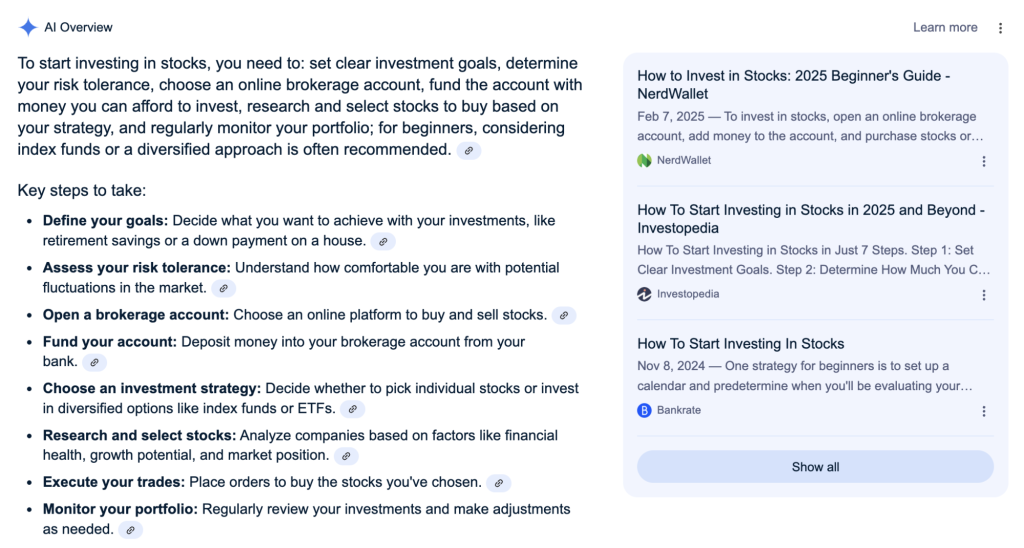
Example of what the Google AI Overview feature looks like in search results

For instance, when searching for complex topics like “how to start investing,” AI Overview combined insights about investment basics from financial websites, risk management strategies from advisory firms, and practical tips from personal finance experts — all consolidated into one coherent summary.

AI Overview Is Changing Search Behavior

Google loves to keep us digital marketers on our toes. The introduction of AI Overview has significantly impacted how users interact with search results in the following ways:

Immediate Answers

The biggest impact of AI overview on SEO is that users can now find complete answers in the AI Overview Box without needing to click through to the full webpage. This shift has noticeably affected click-through rates (CTR) for organic search results, particularly for informational queries.

Comprehensive Information

AI Overview combines relevant information from multiple sources, providing users with a more complete understanding of their topic in the search results page.

For example, if someone searches “content marketing 101,” it might synthesize information about creating a content strategy, identifying target audiences, content pillars, and reporting — all pulled from various authoritative sources into a single comprehensive answer at the top of the page.

Enhanced User Experience

The introduction of AI Overview has been positive for users since it creates a more streamlined search experience. However, the shift presents new challenges for websites that rely on organic traffic from informational searches.

Google AI Overview Impact on SEO Performance

Google’s AI Overview has created several significant changes in the SEO landscape:

  • Decreased click-through rates (CTR) for traditional organic listings
  • Increased competition for remaining organic search traffic
  • Greater emphasis on structured data and content organization
  • New opportunities for visibility within AI-generated summaries

Understanding these changes and how they impact your current SEO strategy is necessary if you want to adapt.

P.S.: If you’re feeling the sting of these reduced click-through rates from this Google update, check out our ultimate guide on how to improve your CTR and get more users engaging with your content.

How to Adapt Your SEO Strategy in 2025

While AI Overview may seem like a disruption to your traditional SEO strategy, it’s important to remember that search engine optimization is ever-evolving. The key to sustainable success isn’t fighting these changes; it’s adapting to them with smart, forward-thinking SEO strategies.

Here’s how you can adjust your SEO approach to flourish in this new landscape.

1. Optimize for AI Overview Visibility

To increase your chances of being sourced in AI Overview summaries:

  • Focus on creating high-quality content that directly answers user queries
  • Structure your content with clear headings and subheadings
  • Use schema markup to help search algorithms understand your content
  • Focus on establishing topical authority in your niche

2. Invest in Your Content Strategy

Develop a strategy that helps you stand out in an AI-dominated search landscape with:

  • In-depth content that addresses your target audience’s search queries and keeps readers engaged
  • On-page optimization (such as title tags, headings, and meta descriptions) to attract more relevant traffic
  • Robust link building efforts to elevate your site’s authority
  • Reporting and metrics that drive continuous improvement

3. Target Strategic Keywords

Adapt your keyword research to focus on:

  • Long-tail keywords that show clear search intent
  • Question-based queries that match user search patterns
  • Informational searches where you can offer unique value
  • Topics where your unique value and expertise can shine through

4. Implement Technical SEO Best Practices

Getting people to your site is only half the battle. When you do capture that valuable website traffic, you want to make sure you’ve got a strong technical foundation to keep them there:

  • Optimize page speed and mobile responsiveness
  • Use proper heading hierarchy and structured data
  • Create clear site architecture
  • Monitor your SEO performance through Google Search Console

Leveraging AI Overview Impact on SEO for Best Results

For many digital marketing professionals, AI can often feel like the enemy. While it presents challenges, it can also offer some golden opportunities for your content.

Use AI Tools to Your Advantage

While AI Overview is changing search rankings, AI tools like ChatGPT and Google’s Gemini can actually strengthen your content marketing strategy when used strategically.

Here’s how to leverage these AI tools effectively.

Content Research and Planning

  • Use ChatGPT to analyze competitor content and identify gaps in current coverage
  • Leverage Gemini’s multimodal capabilities to understand visual content trends in your industry
  • Generate lists of related topics and questions your audience might ask
  • Brainstorm unique angles for common topics in your niche

Search Intent Analysis

  • Use ChatGPT to expand target keywords into comprehensive topic clusters
  • Analyze successful content patterns in your industry
  • Identify emerging trends and user pain points
  • Generate variations of search queries to better understand user intent

Content Enhancement

  • Use Gemini to fact-check and verify statistical information
  • Improve website content structure with AI-suggested headings and subheadings
  • Generate meta descriptions that accurately reflect content value
  • Create content outlines that cover topics comprehensively

A word of advice: AI tools should inform and enhance your content strategy, not replace human expertise and creativity. The most successful content combines AI efficiency with human insight, storytelling, and industry expertise for best results.

Focus on User Experience

With AI Overview providing basic answers, your content needs to deliver deeper value. Here’s how to create an exceptional user experience that keeps readers coming back:

Create Deep, Experiential Content

  • Share real-world case studies and examples from your industry
  • Provide actionable templates and frameworks that users can apply right away
  • Add custom visuals, charts, or infographics that illustrate key points
  • Update content regularly with fresh insights

Develop Unique Perspectives

  • Share original research and data analysis
  • Offer insider tips from industry experience
  • Present contrarian viewpoints backed by evidence
  • Connect different concepts in innovative ways

Build Authority Through Expertise

  • Showcase your team’s specialized knowledge
  • Reference first-hand experiences and results
  • Include relevant industry credentials
  • Maintain consistent brand voice across all content

Drive Meaningful Engagement

  • Create thought-provoking content that encourages discussion
  • Include interactive elements when possible
  • Provide clear next steps or action items
  • Respond to reader comments and feedback

Remember: While AI Overview might answer “what” questions, your content should focus on the “why” and “how” — providing the depth, context and expertise that AI summaries can’t match.

The Future of SEO with AI Overview

As Google continues implementing and enhancing AI tools, successful SEO marketers will need to continue to prioritize high-quality content creation, user experience, and building brand authority in an increasingly competitive digital space.

And remember: while the AI overview impact on SEO is changing things up, it hasn’t eliminated the need for quality content and strong optimization practices.

By understanding these changes and adjusting your strategy to meet these new demands you can boost your search visibility in this evolving SEO environment.

That’s where MBE Group comes in. Our SEO experts and writers can help you create high-quality, authoritative content that resonates with both search engines and readers.

We’ll work with you to develop a comprehensive content strategy, create engaging articles that showcase your expertise, and ensure your content maintains visibility even as search continues to evolve.

Contact us today to learn how we can help you build a content presence that drives real results.

B2C content marketing is evolving faster than ever. Consumers are bombarded with endless social media posts, ads and videos every day, so how can your brand stand out? The key lies in building a content marketing strategy that’s designed for maximum engagement.

In this guide, we’ll explain how B2C marketing differs from its sibling, business-to-business (B2B) marketing and how you can use B2C content marketing to get ahead in even the most competitive spaces.

Four Big Differences Between B2B and B2C Content Marketing

B2C content marketing is very different from B2B content marketing. B2B strategies focus on targeting decision-makers who buy on a slow schedule and require significant amounts of supporting data before they spend a dime. B2C, on the other hand, thrives on emotion, engagement and quick decision-making.

The internet is full of advice tailored to B2B companies, but not necessarily to B2C folks. Following the wrong content strategy could lead to wasted time and effort and you certainly can’t afford to waste resources as a growing business.

Let’s break down the key differences between B2B versus B2C content marketing:

  • Emotional content is king: B2C content should connect with individual consumers on a more emotional level since there are fewer walls between you and your shoppers. There’s no need to put together a data fact sheet or white paper; B2C content marketing relies on experiences and interaction to trigger emotions.
  • Story-first content rules the day: A compelling story sticks with your potential customers far longer than a list of product specs. Successful B2C brands craft narratives that build relationships and evoke emotions, whether through heartfelt testimonials, funny IG reels or aspirational brand messaging.
  • Multimedia leads the way: B2B content marketing is often text-heavy, but everyday shoppers don’t have time to read a long email. B2C content is all about interactive media, like video content and engaging images. Invest in “snackable” multimedia content on social media and other platforms to boost website traffic.
  • Personalization is a must: This is a best practice for both B2B and B2C companies, but the way you implement it will differ. For B2C, personalize content based on shoppers’ buying histories, demographics and other characteristics to offer curated experiences that keep your customers engaged.

Overall, the biggest difference is that B2C gives you the license to be big, bold and emotional. B2C shoppers buy based on their feelings and their immediate needs and also are attracted by trending products.

As a result, B2C marketing tends to be more personal and story-based, which require more out-of-the-box thinking and imaginative content than for B2B.

Five Rules for B2C Content Marketing in 2025

It’s 2025, and your consumers expect high-quality content. That’s well and good, but how exactly can a business create great B2C campaigns especially in an era of crammed email inboxes and overloaded social media feeds?

To succeed, B2C brands need to refine their content marketing strategy, leverage data-driven insight and prioritize the customer experience like never before. Follow these B2C digital marketing best practices to stand out for all the right reasons.

1. Build a Dedicated B2C-Focused Content Marketing Strategy

Do you have a documented strategy for content marketing for B2C? If not, now’s the time to make one and write it down. Content strategy has a lot of moving parts, but you need to create a plan for:

  • Reaching your target audience: To find your target shoppers, define your target buyer personas. Understand your shoppers’ ages, interests, online behavior and pain points. Don’t make assumptions. A little upfront research with actual customers will help you write content that feels more personalized and fosters customer loyalty in the long run.
  • Writing content that moves people: You want people to watch or read your content, but that’s just step one. Ultimately, your content should support lead generation. Every piece of content should end with a call to action (CTA), whether that’s to buy a product or read one of your blog posts to learn more.
  • Content formats: Your customers regularly engage with different types of content, so one format won’t cut it, especially for B2C. Your B2C marketing strategy should plan content for various formats, including video content, infographics, podcasts and social media posts.
  • Covering the SEO basics: Search engine optimization (SEO) is a biggie for both B2B and B2C content marketing. Invest in keyword research to help your brand’s website rank on search engines, which will attract more organic traffic to your site. Take a Wiki-based approach to target multiple high-quality keywords tailored to your target audience’s biggest needs.

2. Nail Your Distribution Platforms

You put in a lot of work to create awesome content. But quality content alone isn’t enough to boost B2C sales — you also need to get your content in front of the right audience. B2C brands need to focus on social media and email marketing to engage individual consumers, increase brand awareness and ultimately drive sales.

With billions of active users, platforms like TikTok, Instagram and YouTube are great spaces for sharing video content and interactive stories. To maximize reach:

  • Share infographics and short-form video content to grab attention quickly
  • Create trend-driven marketing campaigns that will spark conversations
  • Work with influencers to expand your reach and boost brand awareness
  • Maintain a consistent posting schedule to stay top-of-mind with potential customers
  • Offer exclusive content, discounts or early product access
  • Use automation to send tailored content at the right time

For example, Gen Z darling makeup brand Glossier is a master of content distribution. It posts short-form videos on Instagram, YouTube and TikTok sharing user-generated content, product tutorials and behind-the-scenes content to stay continually connected to shoppers.

3. Decide With Data, Not Your Gut

A B2C content marketing strategy will keep you on the straight and narrow, but only if you follow the data. Don’t make changes to your products, website, social posts or landing pages without data to back it up. Brands that rely on analytics instead of intuition see higher conversions, stronger brand awareness and more effective content marketing efforts.

For starters, track your content performance using Google Analytics, HubSpot or another marketing analytics tool. Monitor metrics like:

  • Conversions
  • Engagement rates
  • Organic versus paid traffic
  • Total website traffic
  • Web traffic referral sources, like search engines or social media

Over time, you’ll learn which topics, keywords, content formats and CTAs speak to your audience. Instead of clinging to the old ways of doing things, stay flexible and let the data guide you.

4. Go Multimedia-First

Text-heavy content takes the backseat in B2C content marketing. B2C is all about viral video content and social media posts that speak directly to the prospect’s pain points. Platforms like TikTok, YouTube Shorts and Instagram Reels have made short-form video content a must-have for any B2C company.

Get more eyeballs on your content by leveraging influencer partnerships on these platforms. For example, fitness brand Gymshark collaborates with TikTok influencers to create engaging, relatable content that puts its brand in front of millions of people.

5. Create Valuable Content (Without Losing Your Mind)

B2C content marketing might sound like a lot of work, but we have a trick up our sleeves for creating tons of content in record time. There’s no need to reinvent the wheel; just repurpose content across platforms in different formats.

For example, you can easily convert a customer testimonial into an e-commerce ad with just a few clicks (and the customer’s permission, of course).

Film a single 10-minute YouTube video, and you can quickly generate:

  • A podcast by isolating the video’s audio
  • A blog by transcribing the audio
  • Social posts based on blog blurbs
  • Graphics from social media snippets

Remember, you don’t have to think of something new to say every time you post. Your shoppers are spread across multiple platforms anyway. This approach will help you generate an impressive amount of B2C content marketing that reaches your shoppers across all platforms without filming hours of new content every week.

Build a Content Creation Assembly Line

The B2C space can get super competitive, but a strong content marketing plan will help you stand out. Don’t stick to advice tailored to consulting firms or other B2B companies — follow a unique plan designed to attract the attention and loyalty of your B2C shoppers.

We know you don’t have 10 hours a week to devote to content marketing. You’ve got a business to run, but we can help. B2C companies tap MBE Group to build customer personas, conduct keyword research and create eye-catching content that gets results. Contact us today to reap the benefits of powerful B2C content marketing with zero hassle.

You’re ready to boost your website’s visibility, but you’re stuck at a crossroads: Should you invest in search engine optimization (SEO) or pay-per-click (PPC) advertising?

While these two digital marketing powerhouses might seem like competitors, they’re actually more like dance partners, each bringing unique strengths to your digital marketing strategy.

In this guide, we’ll break down everything you need to know about SEO and PPC, showing you how to leverage both for maximum impact.

What Are SEO and PPC?

Think of search engine optimization like planting a garden. You carefully select your keywords (your seeds), craft your content (the soil), and build quality backlinks (provide water and sunlight) to help it thrive. Yes, growing takes time and care, but once established, your organic traffic flourishes naturally.

A crucial part of SEO is technical optimization, or technical SEO. Think of technical SEO like preparing the soil to ensure conditions are optimal for growth. This includes making sure your website loads quickly, optimizing your site for mobile devices, implementing proper URL structures, and creating XML sitemaps so search engines can better understand your content.

PPC advertising, on the other hand, is less like cultivating ideal growing conditions in a garden and more like renting premium retail space. With PPC, you bid on the keywords you want to target, create compelling ad content, and pay each time someone clicks on your ad. While pay-per-click requires ongoing investment, you’re rewarded with immediate visibility and greater control over your website traffic.

The Cost Factor: SEO vs. PPC

We get it: As a business owner, one of the first questions that probably comes to mind when considering SEO and PPC marketing is “Which is more cost-effective?” Yet the answer isn’t as straightforward as you might think.

The short answer is that SEO is a long-term strategy — it typically requires a larger upfront investment, covering areas like content creation, technical SEO, and linkbuilding. However, once your content is ranking well, that initial investment can drive traffic for months (or even years!) with minimal additional cost.

With PPC, costs tend to be more predictable but ongoing. The average cost per click ranges from $2 to $4 across most industries, but can go up to $50+ in very competitive industries like legal or insurance. Ultimately, your total spend will depend on your industry, the competition, and your PPC campaign goals.

When to Use SEO vs. PPC

Your choice between SEO and PPC should align with your business goals, timeline, and resources. Let’s break down the scenarios where each strategy shines.

Choose SEO When:

  • You’re building long-term brand awareness and authority — SEO campaigns help establish lasting credibility that compounds over time.
  • You have a limited monthly budget but can swing a larger upfront investment in quality content — once your content ranks, it will continue to drive traffic with lower ongoing costs.
  • Your target keywords have high organic click-through rates — users often trust organic results more than ads (with research finding that only 2% of users click on the paid ad in the first position versus 40% clicking on the first organic link).
  • You want to become a thought leader in your industry — high-ranking content positions you as an authoritative voice in your field, so it’s worth investing in if you want to build your reputation.

Choose PPC When:

  • You need immediate website traffic and leads — if you’re working on a big launch or campaign, PPC can start driving qualified visitors to your site within hours of launching.
  • You’re promoting time-sensitive offers or events — paid search ads ensure your promotions get instant visibility when time is of the essence.
  • You want to target specific geographic areas or demographics — online advertising platforms offer precise targeting options that organic search can’t match.
  • You’re testing new market segments or product offerings — PPC campaigns provide quick feedback on market response and conversion rates, which is something to consider before you decide to pivot your organic content strategy to serve a new market.

Why Not Both? The Power of SEO and PPC Integration

This is where things get exciting. SEO and PPC aren’t just compatible — they’re complementary. Here’s how to make them work together to amplify your content marketing return on investment:

1. Share Performance Data

Use data from your paid advertising to inform your SEO strategy. If certain keywords convert well in your PPC campaigns, prioritize them in your organic content strategy. Similarly, high-performing organic content can inspire effective ad copy.

For instance, imagine you run an e-commerce store selling fitness equipment. Your PPC campaigns reveal that the keyword “home gym equipment for small spaces” converts 50% better than “compact home gym equipment.” Armed with this insight, you can integrate the higher-performing keyword in your organic blog content, perhaps creating an in-depth buying guide or product comparison around it.

2. Dominate the SERPs (Search Engine Results Pages)

Imagine someone searches for one of your target keywords and sees:

  • Your PPC ad at the top of the page
  • Your organic listing at the top of the search results
  • Your featured snippet providing a quick answer to their query

You’ve probably witnessed this “triple crown” of search engine dominance with online retail giants like Amazon. Maybe you searched for a popular product like “Bluetooth speaker” and saw Amazon’s listing at the top of the SERPs with a paid ad, as well as an organic listing on the first page and a featured snippet with key product details conveniently listed out for you.

With this triple-packed search presence building trust and recognition with your target audience, you can dramatically increase your click-through rates and drive better outcomes for your business.

3. Test and Refine Your Messaging

Use PPC to quickly test different messages and offers. Once you know what resonates with your target audience, incorporate those insights into your SEO content strategy for long-term success.

Let’s say you’re launching a new line of eco-friendly skin care products. Rather than waiting months to see what messaging resonates organically with your potential customers, you can:

  • Conduct quick A/B testing through PPC advertising highlighting different value propositions (e.g., “zero-waste products” vs. “sustainable packaging”).
  • Use the winning message as the foundation of your organic content strategy for the next quarter.
  • Create targeted landing pages that serve both paid and organic traffic to drive more conversions for your business.

Measuring Success: Key Metrics to Track for SEO and PPC

Success in digital marketing requires careful tracking and analysis of your performance data. Here are the essential metrics you should monitor across both SEO and PPC:

  • Conversion rates: the percentage of visitors who complete desired actions like purchases or sign-ups
  • Cost per acquisition: how much you spend to gain each new customer
  • Cost per click (CPC): the amount you pay each time someone clicks on your ad
  • Return on ad spend: the revenue generated for each dollar spent on paid marketing
  • Click-through rate: the percentage of people who click on your paid search ads or organic listings
  • Quality scores (for PPC): Google’s rating of your Google ad quality and relevance, which affects ad costs
  • Organic rankings (for SEO): Your content’s position in organic search results for target keywords

Kick-Starting Your SEO and PPC Strategy

Ready to harness the combined power of SEO and PPC? Follow these three essential steps to maximize your digital marketing success.

1. Audit Your Current Position

Before you dive into a new strategy, take inventory of your current performance. Here’s what to examine:

  • Existing organic rankings: Understand which keywords you’re already ranking for and where you need improvement.
  • Your competitors’ paid and organic presence: Study what’s working in your industry and identify opportunities to stand out from the crowd.
  • Any content gaps: Identify which search terms your audience is using that aren’t yet being served by existing content.

2. Set Clear Goals

Before launching any new content marketing initiative or PPC campaign, you need a road map for success. Take time to outline your objectives and create concrete targets that your team can work toward by:

  • Defining specific objectives for each channel: Determine what success looks like for both your SEO and PPC efforts.
  • Establishing key performance indicators to measure success: Choose metrics that align with your overall business objectives and revenue goals.
  • Creating realistic timelines for implementation: Set benchmarks for both short-term PPC wins and long-term SEO growth.

3. Allocate Resources Wisely

Achieving a high return on your marketing investment requires smart distribution of both your budget and your team’s resources. Here’s how to make the most of your investment:

  • Invest in high-quality content creation: Develop comprehensive content that drives both your organic rankings and your PPC campaigns.
  • Set aside a budget for PPC testing: Test, test, and then test some more. Start small with A/B testing and scale up based on what works.
  • Hire an expert: Consider partnering with a specialist who understands the content marketing landscape and can maximize your return on investment.

The Bottom Line: Two Is Greater Than One

SEO and PPC aren’t opposing forces; they’re powerful allies in your digital marketing arsenal.

While your SEO efforts will build a lasting organic presence, PPC offers immediate visibility and precise targeting you can use to hone in on what your audience is looking for. Together, they lay the foundation for a digital strategy that drives both quick results and long-term success.

Ready to transform your digital marketing strategy? Let MBE Group help you create a data-driven approach that combines the best of both worlds.

Contact us today to learn how we can boost your online presence through strategic SEO and PPC integration.

Search engine optimization (SEO) is a must if you want to bring more organic traffic to your website. But there’s so much jargon in this space! If you’re trying to DIY SEO for your small business, sometimes it feels like you need to be an SEO expert just to untangle the confusing terms.

Fortunately, you don’t need to be an SEO pro to boost your site’s ranking on search engine results pages (SERPs). You just need the right SEO tools in your corner, plus an understanding of what these tools are measuring and how the metrics should affect your SEO strategies.

If you use Moz or Ahrefs, you’ll recognize the terms Domain Rating and Domain Authority. Both metrics look at the strength of your website’s backlink profile, but they calculate these scores differently.

So, which metric should you prioritize?

In this guide, we’ll break down the differences between DA and DR, how to calculate them, their use cases, and their limitations. Plus, we’ll share actionable tips on how to improve your website authority, earn high-quality backlinks, and create a winning SEO strategy that goes beyond just these numbers.

What Is Domain Rating (DR)?

If you have an Ahrefs subscription, you’ll see your Domain Rating featured prominently in your dashboard. Ahrefs invented DR to help its users understand their website performance. While its rival, Moz, looks at several factors to calculate DA, Ahrefs keeps things simple by only looking at the quality and quantity of backlinks.

Ahrefs calculates your DR score by:

  • Counting the number of unique domains linking to your web pages
  • Calculating the quality of the backlinks
  • Assigning scores on a logarithmic scale from 0 to 100, meaning it’s much harder to go from 80 to 90 than from 10 to 20

DR only looks at link popularity to score your website. If you’ve put your backlink strategy on the back burner, you’ll likely have a lower DR. The good news is that backlinks change all the time, so reinvesting in a backlink outreach can steadily improve your DR over time.

What Is Domain Authority (DA)?

Like Ahrefs, Moz developed Domain Authority to help its users better understand their website’s potential to rank well in Google search. The big difference, though, is that Moz doesn’t just look at backlinks—it looks at several factors, including:

  • The number of linking root domains (like Ahrefs)
  • The quality of backlinks (also like Ahrefs)
  • Your overall link profile, including both no-follow and do-follow links
  • Domain age, since older domains usually have more credibility and stronger website authority
  • Your internal linking strategy

Like Domain Rating, Moz also scales Domain Authority from a scale of zero to 100. Since it monitors more factors, you can expect your DA score to change more over time than your DR score. The good news is that you have more control here—you aren’t focusing solely on convincing other websites to link to yours. In fact, you can get a higher DA score by improving internal links or hanging onto your domain.

Domain Rating vs. Domain Authority

Search engines don’t calculate your domain rating or domain authority. Since Google keeps a tight lip on how, exactly, certain websites rank, DR and DA are helpful proxies for understanding what search engines see when they crawl and rank your site. Still, it’s important to note that Google isn’t checking these metrics—they’re just a helpful tool for tracking SEO progress over time.

While Domain Rating might sound similar to Domain Authority, it’s not quite an apples-to-apples comparison. Let’s look at the main differences between domain rating vs. domain authority.

Calculation

DR and DA aren’t the same because they calculate different factors. Your DA score considers multiple ranking factors, including internal linking and domain age, while your DR score focuses exclusively on link popularity and the quality of backlinks. These differences aren’t a bad thing; it just means you need to pick the metric that best fits your SEO goals.

Use Cases

There’s no clear winner in the tug-of-war between Domain Rating vs. Domain Authority. Both are helpful for assessing your link building strategies, analyzing competitors, and evaluating the overall strength of a website.

Tracking both can be helpful, but if you’re strapped for time, it’s best to focus on one. For example, if backlinks are your number-one priority, go with Domain Rating. DR is better for honing in on assessing link popularity, and especially on the impact of high-quality backlinks on your site’s ranking potential.

But if you’re improving SEO in multiple areas, like backlinks and internal linking, Domain Authority might be more helpful. DA is usually better for measuring website authority in a broader sense, especially if you care about monitoring multiple known Google ranking factors.

Limitations

Remember, your DA score and DR score aren’t official. Google uses complex ranking algorithms, including machine learning, PageRank, and other technical SEO components to rank your site—and it isn’t divulging its secrets any time soon.

Tracking domain rating and domain authority can be helpful, but this approach has a few limitations:

  • A high score doesn’t always translate to better search engine rankings.
  • Not all backlinks are “good” backlinks. Both metrics weigh inbound links differently, but neither can fully account for low-quality or spammy backlinks.
  • While Domain Authority measures more factors, neither DA nor DR tells the whole story. For example, they don’t look at factors like on-page content, user experience, or website traffic, which affect your website’s actual SEO performance.

So, while DR and DA have their time and place, they aren’t the be-all, end-all of SEO. Always check your other metrics, keyword rankings, and analytics to get a better idea of how you’re really doing. Don’t take a single metric too seriously—let multiple factors tell you what’s really going on.

Using DR and DA Effectively for SEO

You should take your DR and DA scores with a grain of salt, but that isn’t to say they don’t have value for SEO. Follow these quick tips to turn these SEO scores into tangible progress:

  • Prioritize high-quality backlinks: Sure, link quantity matters, but both Moz and Ahrefs (and Google, for that matter) care more about the quality of a link. Instead of submitting to low-quality link farms, take the time to create a solid backlink strategy that earns you links from top-quality sites.
  • Monitor your competitors’ scores: You don’t just have access to your Domain Rating and Domain Authority stores. You can also see how your competition ranks! Look for competitors with higher scores and study their link profiles to see where they’re earning backlinks. Research what types of high-quality content they post. While you shouldn’t copy them exactly, you can follow their approach to differentiate your content from what’s already out there.
  • Combine DR and DA with other metrics: DA or DR alone can be misleading. Integrate them with SEO metrics like organic traffic, keyword rankings, and page authority (PA) to better understand your potential to rank. Improving your site speed and mobile friendliness is also great for both the user experience and search engine rankings.
  • Create quality content: A strong SEO strategy isn’t just about backlinks—it’s about creating high-quality content that naturally attracts links and builds website authority over time. Long-form, SEO-optimized articles tend to earn coveted do-follow links, which share link juice across websites. If you don’t have one already, create a content marketing strategy to steadily boost your spot in the SERPs.

Maximize SEO performance Beyond DA and DR

Both Domain Authority and Domain Rating are helpful indicators of your website’s ranking potential, but they’re guides, not guarantees. By combining high-quality backlinks, smart SEO strategies, internal linking, and strong content marketing, you can improve your site authority and drive organic traffic—regardless of what your DA or DR score says.

A higher DA or DR score is helpful, but focusing on website ranking, organic traffic, and overall SEO strategy is what drives long-term success. Skip to the front of the line by partnering with MBE Group. Our expert SEO and content marketing team simplifies the jargon to get measurable results for your website. Contact MBE Group today to boost your website’s reputation.

Search engine optimization (SEO) can improve your website’s rankings in so many ways. But when push comes to shove, your ranking in the search engine results pages (SERPs) comes down to the quality of your content.

Solid writing chops are a must, but your target audience wants more than fancy words on a screen. In fact, the most successful SEO content is tailored to where each customer is in their relationship with your brand. A structured SEO funnel helps you attract, engage, and convert users at different stages of the customer journey—from building brand awareness to driving conversions and fostering loyalty.

Sure, content marketing requires hard work, but why work harder than you should to engage with potential customers? Learning how to tailor your content marketing to user needs will help you drive more organic traffic, improve the user experience, and boost sales.

In this guide, we’ll explain what the SEO funnel is and why you need one, stat. We’ll also break down each stage of the SEO funnel and share actionable strategies to optimize your content for maximum impact.

What Is the SEO Funnel?

The SEO funnel guides searchers through different stages of the customer journey through high-quality content. It mirrors a more traditional marketing funnel by addressing the specific needs of potential customers at each stage: top of the funnel (TOFU), middle of the funnel (MOFU), and bottom of the funnel (BOFU). The stages are also called Awareness, Consideration, and Decision.

While an SEO funnel is similar to a marketing funnel, it has a narrower focus. The SEO funnel captures leads through search traffic by sprinkling relevant keywords into your content. By aligning the SEO funnel with the sales funnel, you can craft an SEO strategy that meets users’ needs at each stage of the funnel, fostering lasting relationships with your target audience.

Why Do I Need an SEO Funnel?

Some businesses prefer to do SEO “organically” and without a plan. This approach can get results, but it will take more time and effort to pull off. An SEO funnel provides a targeted framework for getting results from your SEO efforts.

If you’re on the fence about taking the time to create an SEO funnel, consider just a few of its benefits:

  • Deliver on customer intent: Someone who just found your website has different needs from someone who’s been a regular buyer for years. These two audiences have different needs and expect vastly different content from your website. Creating content for each stage of the customer journey helps you better match search queries, improving the user experience and organic traffic in the process.
  • Boost conversions: An SEO funnel attracts qualified leads to your business. Not every lead will become a customer, but a funnel is helpful for moving more folks through to the conversion stage.
  • Improve the user experience: We’ve said it before, and we’ll say it again: What’s good for users is also good for search engine rankings. A strong SEO funnel encourages you to write more relevant content, which makes users happy. And happy users are much more likely to become customers.

Creating a funnel requires some upfront strategy, but it’s worth the payoff. You’re free to build an SEO funnel yourself, or you can press the easy button and let MBE Group do it for you. Our SEO experts create a custom content strategy tailored to the unique needs of your users for every stage of the SEO funnel.

How to Create Content for Every Stage of the SEO Funnel

Whether you’re just getting started with content marketing or need new ideas for bringing potential customers to your website, an SEO funnel is a must-have. Follow these guidelines to write eye-catching content at every stage of the funnel.

Awareness

In the awareness stage, your target audience is just looking for information. They’re usually looking for answers to a certain problem, but they certainly aren’t ready to throw money at it just yet.

At this stage, you want to position your brand as a helpful authority. Don’t focus too much on your accomplishments or features—we’ll get to that in the next stage. Instead of going in with a hard sell, you should focus on creating high-quality, detailed content that thoroughly answers their questions.

That means creating content like:

  • Educational articles: Write content optimized for relevant keywords and search queries that align with your audience’s pain points. Use SEO tools like Ahrefs or Google Analytics to identify topics with high search traffic and low competition.
  • FAQs: Search engines are increasingly pushing for more zero-click searches, where people can get quick answers without clicking through to your website. Position yourself to show up on these searches by including frequently asked questions on all of your landing pages, product pages, and blogs.
  • Infographics: A picture says a thousand words. Awareness-stage users are looking for simple, digestible answers. If you can succinctly explain a complicated idea or process with a slick infographic, you’ll turn more heads (and gain a few backlinks in the process).
  • Video explainers: Not everyone is into reading blogs or even looking at infographics. You can catch more organic traffic by generating short, high-quality explainer videos on YouTube or TikTok.

Some folks will fall out of the SEO funnel at this stage, and that’s okay. The people who find value in your brand will continue their journey to the Consideration stage.

Consideration

In the Consideration stage, people are aware of their problem and are actively exploring solutions to fix it. If you did your job in the Awareness stage, your audience will start considering your brand as the answer to their needs.

Now’s the time to dazzle potential customers with details about your brand. But you still shouldn’t spam them with boring feature lists. Consideration stage users don’t really care about that; they want to know how your brand solves their problems. What value do you provide? How will you make their life better?

At this stage of the SEO funnel, invest in content like:

  • Success stories: Detailed case studies are a helpful way to show how you solve client problems. Highlight real-world examples and testimonials of how your product helps others to get some much-needed social proof and credibility.
  • Comparison guides: Chances are, you have competitors. Comparison guides help your audience untangle what makes you different from every other solution on the market. Again, the goal here isn’t to talk about yourself—make the potential customer the star of the show.
  • Webinars and demos: How-to videos, tutorials, and webinars are helpful for giving users a better idea of what your product or service is actually like (without giving away the secret sauce).

Decision

Here’s where things get juicy. At the Decision stage, users are ready to choose a solution. Not to spook you, but this is arguably the most crucial point of the SEO funnel. At this stage, your focus should be on converting interested users into paying clients.

The goal is to eliminate doubt and showcase why your brand is (obviously) the best choice for their needs. Now’s the time for salesy language and appeals tailored to making a transaction.

Effective Decision stage SEO funnel content includes:

  • Landing pages: Create highly targeted landing pages optimized with relevant keywords and compelling calls to action (CTAs) that encourage users to take the next step. Don’t create one landing page for all of your campaigns; create separate ones tailored to different keywords, audiences, and campaigns to boost conversion rates.
  • Optimized product pages: If you’re in e-commerce, product pages do a lot of the selling for you. Take a good, hard look at your e-commerce listings to verify product details, titles, and even your back-end alt text to nudge users to make a purchase.
  • Remarketing content: It’s frustrating, but plenty of people will add an item to their cart or sign up for a demo and … disappear. It happens! Instead of letting these warm leads disappear, create remarketing campaigns to bring them back into the fold. That includes retargeting ads and email reminders, although a well-timed discount doesn’t hurt, either.

While there are three main parts to the SEO funnel, it’s important to realize that your work isn’t done once a Decision stage customer converts. You want to keep them around for the long haul, which requires ongoing retention.

At the retention stage, your goal is to preserve customer loyalty and engagement. Offer these customers loyalty programs, user-generated content from other happy shoppers, personalized emails, and social media engagement to keep the party going.

Digital Marketing Done for You

It takes a little elbow grease to strategize different types of content for each stage of the SEO funnel. Still, the payoff is worth it. Whether you’re struggling to get traffic to your content or don’t know where to start, an SEO funnel provides a helpful framework for winning over more customers.

The tips in this guide are a good start, but you still need time and capacity to create funnel-optimized content. There’s no need to spend hours a week creating content yourself—outsource the heavy lifting to MBE Group. Our expert SEO and marketing pros handle everything from designing your funnel to writing all-star copy that wins you more clients for less hassle.

It’s time to level up. Contact MBE Group today to design your SEO funnel.

Troy, Mich. – January 29, 2025 – Marx Buscemi Eisbrenner Group (MBE Group), a full-service global marketing communications agency highly focused in the transportation, mobility, tech, and consumer goods industries, announced that, effective January 16, 2025, it has acquired 100% of the shares of Growth Machine (www.mbe.group).

Founded in 2017, Growth Machine is a boutique content marketing agency based in Chicago – but with a fully remote workforce – that specializes in B2C and B2B digital content creation and SEO for consumer goods, tech, and e-commerce brands. The company has experience with industry stalwarts such as Adobe, ClickUp, and Yelp!, as well as direct-to-consumer companies like Nature’s Aid, Butcher Box, and Greenlight.

All Growth Machine employees will become part of MBE Group, including Nora Schlesinger, CEO of Growth Machine, who will join MBE Group as vice president and be part of the agency’s leadership team.

“Growth Machine has a proven track record of consistent, results-driven work and tremendous market knowledge, along with an experienced and well-connected leadership team that has created a fantastic culture rooted in collaboration and creating value for clients,” said Tom Eisbrenner, president, MBE Group. “They will be a perfect addition as we look to enhance and expand our digital capabilities and reach within the tech and consumer goods markets – while enabling us to remain market specialists.”

With a heritage dating back to 1984, MBE Group provides strategic and tactical marketing communications services that include brand development, public relations, advertising, social media, web development, crisis communications, digital design, and event support. Additionally, the company provides government and industry relations, product development, and market planning. Its primary industries include the global mobility industry – automotive, aftermarket, trucking, marine, defense, aerospace, and recreational vehicles – as well as tech, and e-commerce.

“When looking at what was next for our team, we wanted to find a buyer that fully understood our capabilities, but also had great culture that aligned with ours, and a clearly defined path for our role in the growth and development of the overall company,” Schlesinger said. “MBE Group is the ideal fit.”

The deal increases MBE Group’s overall size by 30%. The company’s headquarters will remain in the Detroit area.

“Adding Growth Machine into the fold creates significant opportunity for our company, our staff, and our clients,” said Frank Buscemi, CEO, MBE Group. “Digital marketing evolves on an almost-daily basis, and expanding our capabilities in content creation, data tracking and management, and audience engagement enables us to stay one step ahead of this evolution.”

Terms of the deal will not be disclosed.

Do you have a project you need support with? Let's chat.

Get In Touch

ABOUT MBE GROUP

With 40+ years in mobility, tech and consumer goods, we build brands and solve tough challenges through smarter strategies, seamless design and solutions that scale.

SUBSCRIBE TO E-NEWSLETTER

    Built with Kit

    Office

    1441 West Long Lake Rd.
    Suite 330
    Troy, MI 48098

    Do you have a project you need support with?
    Let's chat.

    Get In Touch

    ABOUT MBE GROUP

    With 40+ years in mobility, tech and consumer goods, we build brands and solve tough challenges through smarter strategies, seamless design and solutions that scale.

    SUBSCRIBE TO E-NEWSLETTER

      Built with Kit

      DETROIT HQ

      1441 West Long Lake Rd.
      Suite 330
      Troy, MI 48098

      Copyright ©2026 MBE Group. All rights reserved.

      Privacy Policy

      Copyright ©2026 MBE Group.
      All rights reserved.
      Privacy Policy